Top 15+ Best Phishing Tools for Everyone (2026)

In this Article, we will talk about 10 Best phishing tools which can help in strengthen your organization from various type of phishing attacks.

May 19, 2023
37 min read
Best Phishing tools

Phishing remains a prevalent and successful attack vector. Cybercriminals use fraudulent emails, fake website links, or deceptive messages to compromise sensitive data. Their goal is to trick users into divulging personal credentials, financial information, or other private data, leading to unauthorized access and potential financial loss. The pervasive nature of phishing attacks demands strong defensive strategies.

Cybersecurity professionals use specialized phishing tools to counter this threat. These tools help ethical hackers strengthen an organization’s defenses. They also enable realistic phishing simulation exercises to assess vulnerabilities and improve resilience.

Simulating various phishing campaign scenarios tests security protocols. This also enhances employees’ security awareness training.

This article presents the top 10+ phishing tools for 2026. We explore both advanced commercial solutions and powerful free options. These tools can significantly improve your organization’s cybersecurity posture.

Whether implementing phishing simulation programs or conducting targeted phishing training, this guide offers insights into effective tools. Learn to identify, prevent, and mitigate the impact of phishing to protect your data.

Best Phishing Simulation Tools for Organisations

Phishing simulation tools mimic real attacks. They test employee susceptibility, improve security awareness, and reduce human risk.Organizations need these tools to identify “human firewall” vulnerabilities. They then provide targeted training based on findings.

Prioritize key features when selecting commercial tools. Look for customizable templates, comprehensive reporting, and integration with existing security infrastructure. Multi-language support and scalability are also crucial.

The right tool enables realistic phishing campaigns. It identifies weaknesses and ultimately reduces successful phishing attack risk.

Platform

Key Highlights

Unique Features

PhishGrid

Free, web-based phishing simulation

AI-based phishing attacks, employee risk scoring, redirection to awareness pages, customizable templates & content

KnowBe4

World’s largest platform (65k+ customers)

Gamification, multi-language support, automated training campaigns, badges & leaderboards

Hoxhunt

Human Risk Management solution

Personalized micro-trainings using AI + behavioral science, automated incident resolution

MetaCompliance

Awareness + compliance + policy training

Policy management, privacy, risk management, Azure-hosted, SSO, remote access

Proofpoint

Threat intelligence-driven learning

600+ modules, adaptive learning, 40+ languages, PhishAlarm reporting button, CISO dashboard

Arctic Wolf

Engaging interactive training

Realistic phishing simulations, quizzes, videos, performance analytics

NINJIO

Behavioral science-driven training

NINJIO Risk Algorithm, personalized vulnerability-based training

SoSafe

People-centered risk management

GDPR-compliant workshops, personalized simulations, behavioral algorithms

SANS Institute

Trusted cybersecurity leader

Assessments, corporate comms, phishing simulation, wide content library

Hacker Rangers

Fully gamified training

Leaderboards, ranks, badges, bite-sized lessons, quizzes, animated content

1. PhishGrid

PhishGrid is an online platform for rapid phishing simulations. It combines attack simulation with awareness education.

Phished users are redirected to relevant content. This identifies vulnerabilities and strengthens human defenses.

PhishGrid offers many customizable phishing templates. These mirror current attacker tactics, from fake security alerts to internal communications. Organizations can tailor templates for specific departments.

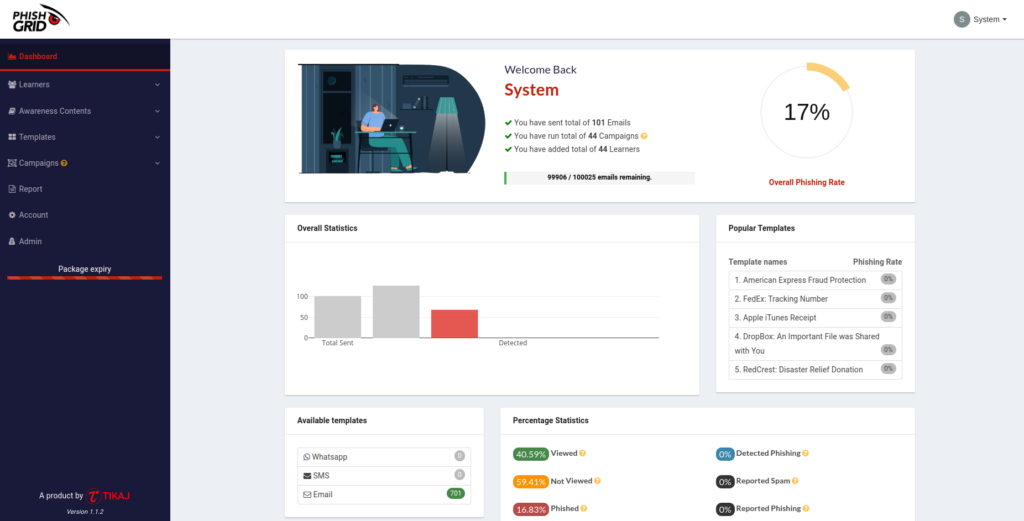
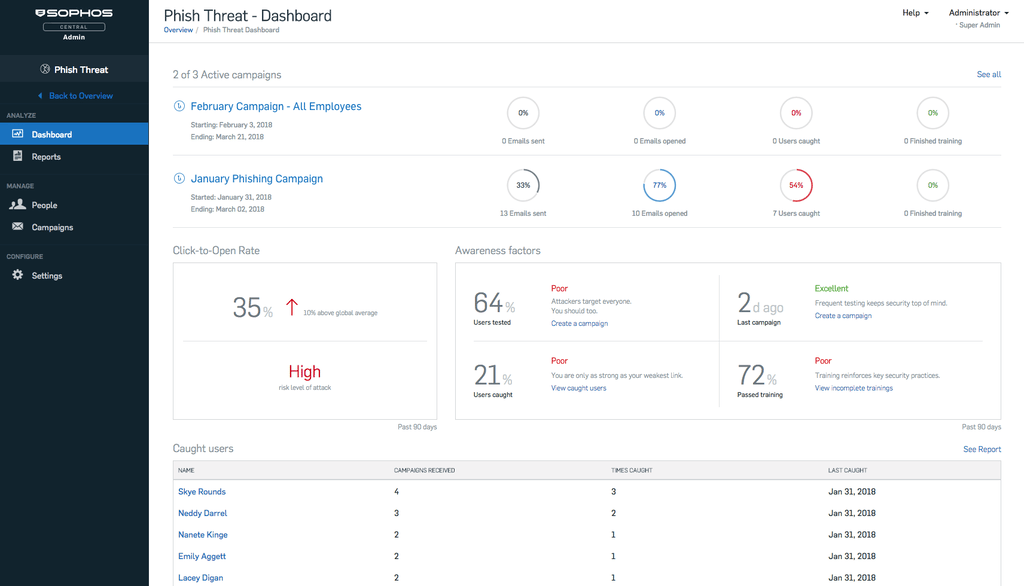
The platform provides strong campaign management features. Users can schedule campaigns, track progress, and analyze results through dashboards. This reporting shows employee susceptibility and guides focused training.

AI Integration & User-Friendly Framework

AI integration enhances PhishGrid’s capabilities for sophisticated simulations. This feedback loop refines security awareness programs. It reduces the risk of successful phishing attacks.

PhishGrid’s user-friendly framework allows content selection or creation. This makes security awareness training adaptable and effective.

The dashboard provides clear insights into an organization’s phishing rate, including user clicks, views, and most vulnerable users. PhishGrid stands out as an advanced phishing simulation tool in the industry, incorporating AI-based phishing attacks, employee risk scoring, and new phishing trends to drive culture change. The best part is that it’s free; users can sign up and start using it immediately.

Why Choose PhishGrid?

  • Cost-Effective: PhishGrid is a free, web-based platform, making it accessible for organizations of all sizes.

  • AI-Powered Simulations: It integrates AI for advanced, realistic phishing attack scenarios and employee risk scoring.

  • Comprehensive Awareness: The platform redirects phished users to customizable awareness content, reinforcing training.

  • Actionable Analytics: Dashboards provide clear insights into phishing rates, user clicks, and vulnerable employees.

Features:

  • Large number of templates

  • Integrated with AI

  • Large number of Awareness content

  • Up-to date contents

2. KnowBe4 Security Awareness Training

KnowBe4 is the world’s largest integrated security awareness training and simulated phishing platform, serving over 65,000 customers globally. It provides a user-friendly, intuitive, and powerful solution for enhancing an organization’s human firewall. The platform’s core offering focuses on reducing human risk through comprehensive training and realistic phishing simulations.

One key feature is its extensive content library, offering a wide range of training modules and simulated phishing templates. KnowBe4 also supports multi-language options for both the admin console and end-users, ensuring a more immersive learning experience. This global reach makes it ideal for organizations with diverse workforces.

KnowBe4 helps organizations build a human firewall by automating training campaigns with scheduled reminder emails. It also incorporates gamification features, allowing users to compete on leaderboards and earn badges, which increases engagement and retention. This approach makes learning how to identify and report cyber threats more interactive. KnowBe4 is ideal for organizations of all sizes seeking comprehensive security awareness, with some free options available for smaller entities.

KnowBe4 - Best Phishing Tools

3. Hoxhunt

Hoxhunt is a Human Risk Management solution that moves beyond traditional security awareness by focusing on behavioral transformation. It aims to achieve a quantifiable reduction in human-related cybersecurity risk. This platform leverages a blend of artificial intelligence and behavioral science to deliver personalized micro-training experiences.

One specific feature is its tailored training encounters, which users find engaging and relevant. Hoxhunt empowers employees to identify and report sophisticated phishing attacks effectively. Another key feature is its automated incident resolution process, which streamlines operations for security teams. This allows teams to act swiftly despite resource constraints.

Hoxhunt surpasses traditional solutions by providing real-time feedback and continuous learning based on actual user interactions with simulated threats. For example, if an employee falls for a simulated phishing email, Hoxhunt immediately provides targeted training on that specific threat vector. This proactive, personalized approach helps organizations build a more resilient workforce. Hoxhunt is ideal for organizations focused on proactive, human-centric security strategies.

Hoxhunt - Best Phishing Tools

4. MetaCompliance Security Awareness Training

MetaCompliance provides an integrated platform for security awareness, compliance, and policy management. This solution helps enterprises meet regulatory obligations and reduce human risk through comprehensive training. It offers a multi-lingual suite of capabilities, including policy management, eLearning, and simulated phishing attacks.

Key features include policy management, which centralizes and automates policy distribution and acknowledgment. The eLearning modules deliver personalized security awareness training content, accessible remotely and on various devices. Simulated phishing attacks, termed ‘mimic attacks,’ test employee susceptibility and reinforce training.

Organizations benefit from MetaCompliance’s ability to accommodate non-network users through forms-based authentication. This ensures all personnel, regardless of their network access, complete essential compliance training. Such integration saves significant time and costs associated with managing diverse training requirements across an enterprise.

MetaCompliance - Best Phishing Tools

5. Proofpoint Security Awareness Training

Proofpoint Security Awareness Training uses a threat intelligence-driven approach to reduce people-centric risks. It enhances overall security posture and supports compliance initiatives. This platform builds on established learning principles to drive behavioral change and improve knowledge retention.

The solution integrates real-world threat data into its training modules. This ensures employees learn to recognize and respond to current, sophisticated phishing attacks. Adaptive training frameworks tailor content to individual learning styles, roles, and competency levels, available in over 40 languages.

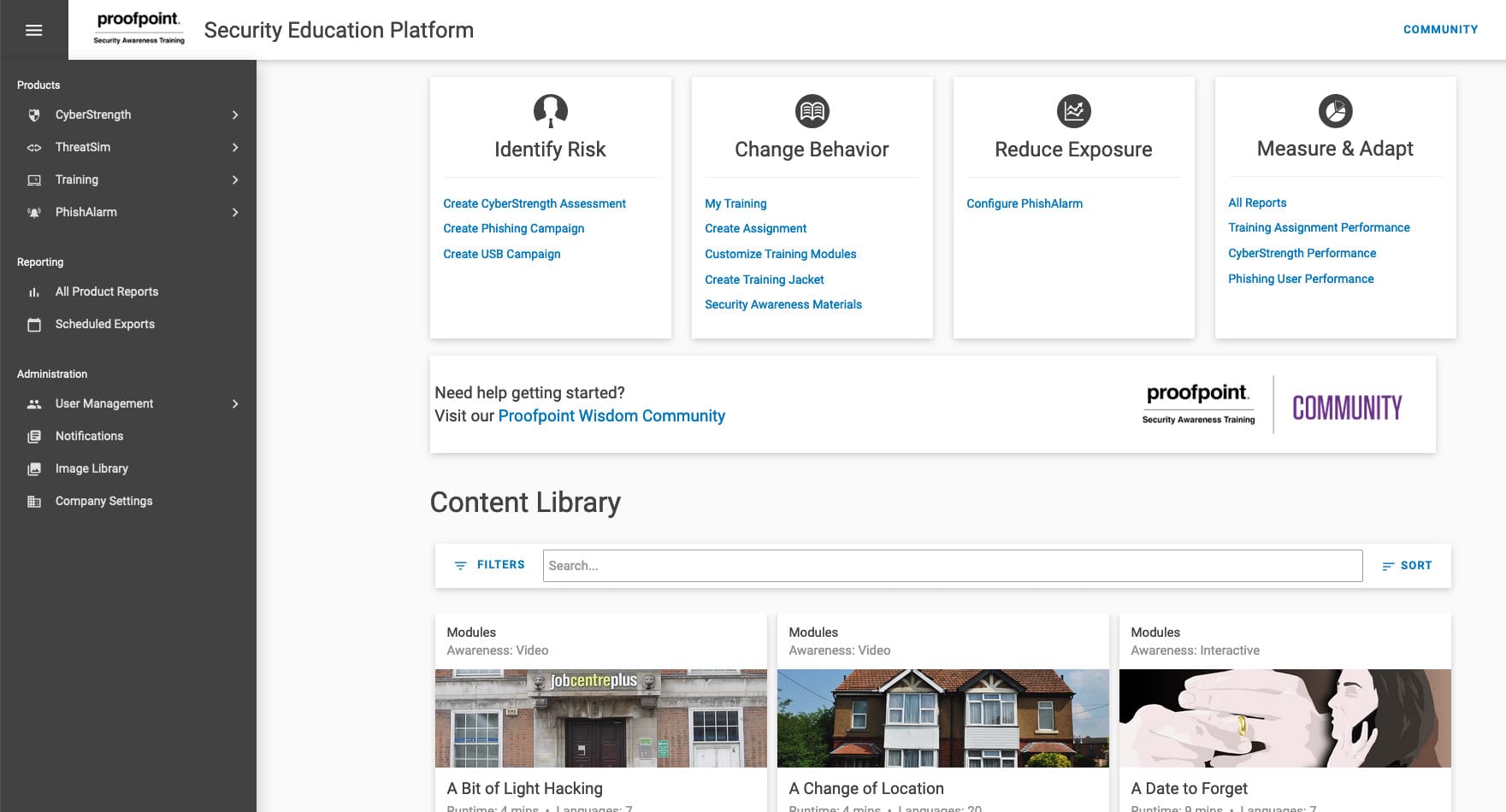
Proofpoint offers knowledge and culture assessments to pinpoint specific knowledge gaps and evaluate security attitudes. Attack simulation layouts, modeled after actual threats, equip learners with practical skills. For example, integrating the PhishAlarm email report button into their CLEAR infrastructure streamlines security response, reinforcing positive behavior when users report suspicious emails. This proactive approach significantly enhances organizational resilience against targeted threats.

Download FREE Security Awareness Plan Template

Secure Success with Our Free Security Awareness Plan Template – Download Today!

Download for free

An adaptive learning framework encompassing a comprehensive library of over 600 learning components. These components can be tailored to align with users’ preferred learning styles (interactive, gamified, micro or nano content), their roles, competency levels, or specific domain-knowledge requirements. The modules are accessible in over 40 languages and can be customized to reflect the organization’s identity.

The PhishAlarm email report button is seamlessly integrated into their CLEAR infrastructure, streamlining security response and reinforcing positive behavior change when users report suspicious emails.

The CISO Dashboard and pre-configured reports, enable administrators to benchmark their progress against industry peers and effortlessly convey the program’s impact to their executive team.

Proofpoint - Best Phishing Tools

Free Phishing Tools for Learning and Testing

Free phishing tools and open-source phishing tools are software applications designed for learning, ethical hacking, and small-scale security testing. These tools allow individuals and organizations to understand phishing attack mechanics and practice defensive strategies. They are crucial for accessibility and skill development in cybersecurity.

While enterprise-grade phishing simulation platforms offer extensive features and dedicated support, not everyone requires or can afford such comprehensive solutions. For individuals, students, small businesses, or those just beginning their journey into cybersecurity, a wealth of free phishing tools exists. These tools are invaluable for understanding the mechanics of a phishing attack, practicing defensive strategies, and conducting basic phishing simulation exercises without a significant financial outlay. They serve as excellent resources for security awareness training and for testing the resilience of your own email security measures.

Benefits of Using Free Phishing Tools

Free phishing tools offer several advantages for individuals and organizations exploring cybersecurity. These benefits extend beyond simple cost savings, providing flexibility and community support.

  • Accessibility: Free tools democratize access to phishing simulation capabilities, allowing anyone to learn and experiment. This lowers the barrier to entry for cybersecurity education.

  • Cost-Effectiveness: Ideal for students, researchers, or small organizations with limited budgets, these tools provide practical experience in identifying and mitigating phishing threats without financial outlay. Startups can test their defenses without significant investment.

  • Flexibility and Customization: Many open-source tools allow developers to modify code, integrate with other systems, and create highly specific testing scenarios. This adaptability supports unique research or training requirements.

  • Testing and Validation: Useful for basic testing of email security filters and user susceptibility to common phishing email tactics. Organizations can validate their existing security controls.

  • Community Support: Many open source phishing tools benefit from active communities that contribute to development, offer support, and share phishing templates. This collaborative environment provides valuable resources and troubleshooting assistance.

Limitations of Free Phishing Tools

Free phishing tools offer valuable functionality but come with inherent limitations. These restrictions often impact scalability, support, and the overall sophistication of phishing simulations.

  • Limited Features: Free versions often lack the advanced reporting, automation, extensive template libraries, and integration options found in commercial platforms. Users might find themselves manually performing tasks that paid tools automate.

  • Scalability Issues: These tools are not designed for large-scale phishing campaign deployments or complex organizational structures. Scaling up operations with free tools can become resource-intensive and inefficient.

  • Lack of Dedicated Support: While community support exists for open-source phishing tools, dedicated technical support is typically absent. Users must rely on forums or self-help resources for troubleshooting.

  • Steeper Learning Curve: Many free and open-source tools require a higher degree of technical proficiency for setup, configuration, and ongoing maintenance. This can be a barrier for organizations without dedicated cybersecurity staff.

  • Potential Security Risks: If not properly configured or maintained, open-source tools can introduce security vulnerabilities. Users are responsible for ensuring the tool itself is secure and up-to-date.

  • Maintenance: Users are responsible for setting up, configuring, and maintaining the tools themselves. This includes applying patches and updates, which requires some technical proficiency and time commitment.

Recommended Free and Open-Source Phishing Tools

Several excellent free and open-source phishing tools are available for educational purposes, initial testing, or for organizations with specific technical expertise. These tools allow users to conduct phishing simulations, test employee awareness, and understand attack vectors without significant financial investment.

This section introduces some of the most prominent free and open-source options. We will explore tools like Gophish, King Phisher, the Social-Engineer Toolkit (SET), and Evilginx2. Each offers distinct capabilities for creating and managing phishing campaigns, from email-based attacks to advanced credential harvesting.

When utilizing these free phishing tools, it’s crucial to remember to do so ethically and legally. Always ensure you have explicit permission before conducting any phishing simulation on systems or individuals you do not own or manage. These tools are powerful educational instruments for enhancing cybersecurity posture and understanding the nuances of phishing, but responsible use is paramount.

6. Arctic Wolf

Arctic Wolf provides a comprehensive security operations solution, including managed detection and response (MDR) and security awareness training. Their approach integrates human expertise with advanced technology to deliver tailored cybersecurity outcomes for organizations.

Arctic Wolf’s security awareness training focuses on both general security education and organization-specific content. They employ engaging learning methods like videos, simulations, and quizzes. These interactive elements help employees grasp complex security concepts and retain crucial information effectively.

A key feature is their phishing simulations, which mimic real-world attacks. These simulations allow employees to experience threats in a safe environment. Tracking employee responses helps organizations identify vulnerable areas and target further training. The platform provides detailed reports and analytics on participation and performance, enabling management to assess workforce security awareness and pinpoint improvement areas.

7. NINJIO Security Awareness

Through engaging training, individualized testing, and insightful reporting, NINJIO reduces human-based cybersecurity risk. It focuses on the latest attack vectors to build employee knowledge and the behavioral science behind human engineering to sharpen users’ intuition.

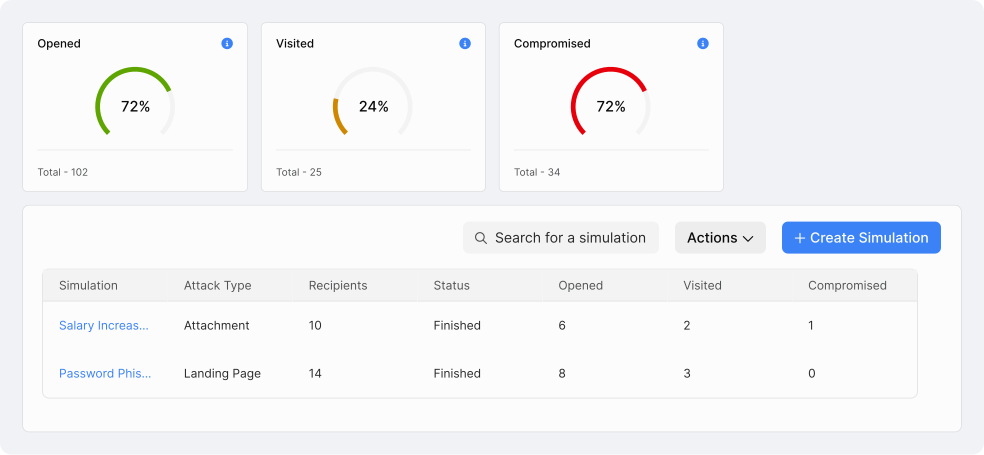
NINJIO Risk Algorithm identifies users’ social engineering vulnerabilities based on simulation data and informs content delivery to provide a personalized experience that changes individual behavior.

NINJIO - Best Phishing Tools

8. SoSafe

SoSafe specializes in people-centered cybersecurity awareness training and human risk management. Their GDPR-compliant awareness workshops help firms develop a robust security culture and mitigate human-related cyber risks effectively.

SoSafe delivers engaging, individualized learning experiences. These are powered by behavioral science and intelligent algorithms. The platform transforms employees into active assets against online attacks by enhancing their understanding and response capabilities.

A core offering includes sophisticated attack simulations. These simulations provide realistic scenarios to test employee vigilance. SoSafe’s approach aims to foster a proactive security mindset within organizations, reducing the likelihood of successful phishing attacks.

SoSafe - Best Phishing Tools

9. SANS Security Awareness Training

SANS Security Awareness Training provides comprehensive programs to reduce human risk in organizations. This commercial solution offers a structured approach to educate employees on cybersecurity best practices and identify vulnerabilities.

The platform includes a wide range of resources, such as short-form technical material and brandable corporate communications. Organizations can integrate SANS’ expertise into their human risk management strategies.

SANS also provides workforce assessments to pinpoint knowledge gaps and readiness levels within an organization. These assessments help tailor training efforts for maximum impact.

SANS Security Awareness Training - Best Phishing Tools

10. Hacker Rangers Security Awareness

Hacker Rangers Security Awareness

Hacker Rangers offers a gamified security awareness training platform designed to engage employees through interactive experiences. This commercial tool transforms cybersecurity education into a competitive game, improving learning retention.

The platform incorporates elements like leaderboards, badges, and ranks to motivate employees. This approach encourages the adoption of secure behaviors through enjoyable competition.

Hacker Rangers delivers short, bite-sized lessons covering topics like identifying fake messages and social manipulation tactics. Educational materials include animated videos, handouts, and quizzes for a diverse learning experience.

Hacker Rangers - Best Phishing Tools

Download FREE Security Awareness Plan Template

Secure Success with Our Free Security Awareness Plan Template – Download Today!

Download for free

Best Tools for Phishing Attacks (Ethical Hacking)

Phishing tools for ethical hacking are specialized utilities used by cybersecurity professionals to simulate real-world phishing attacks. These tools help identify vulnerabilities in an organization’s human and technical defenses during penetration testing.

Ethical hackers use these tools to mimic sophisticated threats, such as credential harvesting and malware delivery. This proactive testing allows organizations to strengthen their security posture against social engineering tactics.

Tool

Key Highlights

Unique Features

Simple Phishing Toolkit

An open-source phishing framework, web-based and user-friendly for initiating basic phishing campaigns.

Features awareness education video redirection and simplifies the creation of free, effective phishing attack scenarios.

King Phisher

Designed for real-world phishing attack simulations, making it a robust phishing tool for ethical hacking.

Supports multi-campaign operations, geo-location tracking, web cloning, and message tracking with embedded images for detailed analysis of phishing email effectiveness.

Social-Engineer Toolkit (SET)

A comprehensive open-source phishing and penetration testing framework, essential for advanced ethical hacking.

Offers a wide range of social engineering attacks, including spear-phishing and credential harvesting, with Python-based integration for enhanced cybersecurity assessments.

Gophish

An intuitive open-source phishing campaign toolkit, perfect for managing various phishing attack scenarios.

Provides a user-friendly web UI, customizable phishing emails and landing pages, a strong reporting engine, and the ability to host free phishing sites for effective phishing simulation.

Evilginx2

A sophisticated man-in-the-middle attack framework, crucial for testing defenses against advanced phishing attacks.

Excels at bypassing 2FA, enabling real-time phishing, session cookie theft, and redirection to legitimate sites after credential capture, making it a powerful phishing tool for ethical hacking.

Blackeye

An open-source phishing tool that streamlines the creation of convincing phishing pages.

Automates the generation of various phishing templates and captures credentials efficiently, serving as a popular alternative to Zphisher for quick phishing attack setups.

Hidden Eye

A multi-functional phishing tool for comprehensive ethical hacking operations.

Combines phishing with keylogging capabilities, brute-force attacks, information gathering, and other social engineering tactics to simulate complex phishing attacks.

Modlishka

An advanced reverse proxy phishing tool, ideal for sophisticated phishing attack simulations.

Facilitates real-time traffic interception and modification, and auto-generates phishing pages, making it a cutting-edge solution for bypassing modern security measures.

Phishing Frenzy

An open-source phishing framework designed for cybersecurity professionals and advanced phishing campaigns.

Offers web-based management for customizable scenarios and integrates with third-party services to enhance the realism and scope of phishing attack simulations.

Wifiphisher

A specialized wireless phishing attack simulator, focusing on network-level vulnerabilities.

Creates fake Wi-Fi access points and gathers credentials via captive portal phishing pages, demonstrating a unique vector for phishing attacks in an ethical hacking context.

1. Simple Phishing Toolkit

Simple Phishing Toolkit (SPT) is an open-source, web-based framework designed for creating and managing basic phishing campaigns. It provides an accessible entry point for ethical hackers and security professionals to conduct phishing simulations.

SPT features a user-friendly web interface that simplifies campaign setup and management. This ease of use makes it suitable for beginners in penetration testing.

A key feature is its ability to redirect phished users to an awareness education video. This combines phishing tests with security awareness training, offering immediate educational feedback. SPT also facilitates credential harvesting, allowing testers to evaluate an organization’s susceptibility to credential theft.

Simple Phishing Toolkit - Best Phishing Tool

2. King Phisher

King Phisher is designed for testing and promoting user awareness by simulating real-world attacks.

This tool provides many features, including the ability to run multiple campaigns simultaneously, geo-location of phished users, web cloning capabilities, and more.

King Fisher server is only supported on Linux, with additional installation and configuration steps required depending on flavor and existing configuration.

According to the official documentation, it also supports sending messages with embedded images and determining when emails are opened with a tracking image.

King Phisher - Best Phishing Tool

3. Social-Engineer Toolkit (SET)

The Social-Engineer Toolkit (SET) is a comprehensive open-source penetration testing framework focused on social engineering attacks. Built on Python, SET integrates various security tools to create a versatile platform. It helps security professionals assess an organization’s susceptibility to human-centric attacks.

SET offers diverse attack vectors, including spear-phishing, web jacking, and infectious media generators. It can harvest login credentials and deploy new phishing types. This versatility makes it a critical tool for advanced ethical hackers and red teams.

For example, an ethical hacker could use SET to create a fake USB drive payload that, when inserted, executes malicious code. Another scenario involves setting up a web jacking attack to redirect users to a malicious site. SET’s broad range of modules allows for highly customized and realistic social engineering simulations.

Social-Engineer Toolkit (SET) - Best Phishing Tool

4. Gophish

4. Gophish

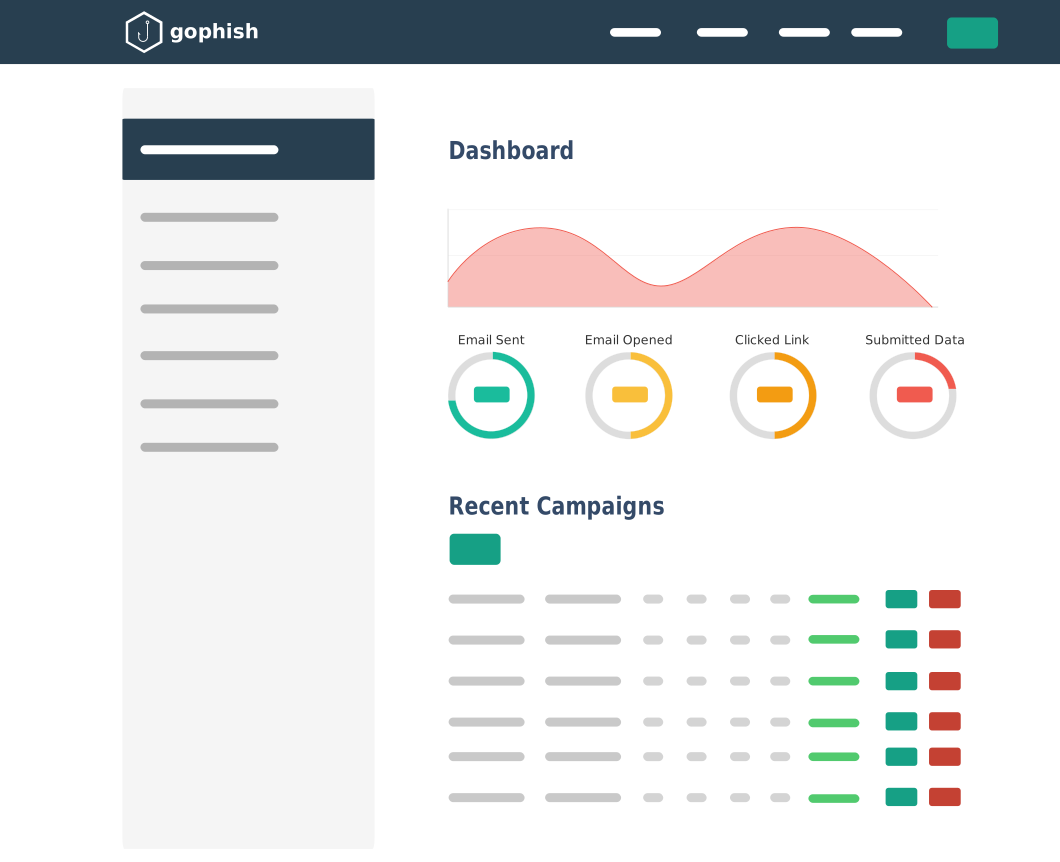
Gophish is a popular open-source toolkit designed for creating and managing phishing campaigns. It provides a user-friendly web-based interface, making it accessible for both businesses and penetration testers. This tool is widely used for security awareness training and simulating real-world phishing scenarios.

Key features include intuitive campaign creation, allowing users to design custom email templates and landing pages.

It offers robust tracking capabilities for responses and clicks, providing detailed insights into campaign performance. Gophish also comes with a powerful reporting engine to identify areas for improvement.

For instance, a security team might use Gophish to simulate a credential harvesting attack on their employees. They can track who clicks the malicious link and who submits credentials, then use this data for targeted training. The framework’s active community contributes to its continuous development and support.

Gophish - Best Phishing Tool

5. Evilginx2

5. Evilginx2

Evilginx2 is an advanced man-in-the-middle (MitM) attack framework used for sophisticated phishing operations. It specializes in harvesting login credentials and session cookies, even bypassing two-factor authentication (2FA). This tool is particularly effective against online services like Gmail, Yahoo, and Facebook.

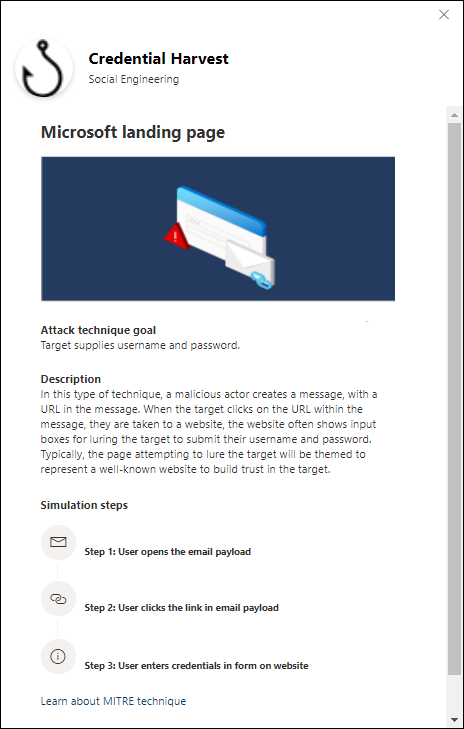
Its core feature is real-time phishing, where it intercepts user login details and session cookies. Evilginx2 creates a virtually identical fake login page, then immediately redirects the user to the legitimate website after credential entry. This makes detection difficult for the target.

For red teaming exercises, Evilginx2 allows security professionals to simulate highly advanced phishing attacks that bypass common security measures.

This helps organizations understand their vulnerability to sophisticated adversaries. Its ability to capture session cookies enables session hijacking, providing access without needing the password directly.

Evilginx2 - Best Phishing Tool

6. Blackeye

Blackeye is an open-source tool designed to automate the creation of classic phishing pages. It focuses on capturing user login details through imitation. This tool functions similarly to zphisher, offering a straightforward alternative for quick deployment.

Key features include a wide range of pre-built templates for popular services like Facebook, Google, and Instagram. Its easy setup allows users to quickly generate a fake login page. Blackeye captures entered credentials and stores them on the attacker’s machine.

For example, a security researcher might use Blackeye to quickly set up a phishing page for a simulated attack. They can select a template, launch the page, and then capture any credentials entered by test subjects. This allows for rapid deployment of phishing campaigns to assess user vulnerability.

Blackeye - Best Phishing Tool

7. Hidden Eye

Hidden Eye is a versatile phishing tool designed for various online attacks. It enables users to generate convincing phishing pages and deploy social engineering tactics. This tool supports credential harvesting and information gathering across multiple platforms.

The tool offers pre-built templates for popular services like Facebook, Google, and Instagram. Users can quickly set up a phishing campaign by selecting a template and configuring the target URL. Hidden Eye then hosts the fake page, collecting credentials entered by victims.

For ethical hacking, Hidden Eye can simulate credential theft scenarios. A security team might use it to test employee susceptibility to phishing. This helps identify vulnerabilities in human defenses and improve security awareness training programs.

8. Modlishka

Modlishka is a powerful reverse proxy tool for advanced phishing attacks. It intercepts and modifies traffic between a victim and a legitimate website. This capability allows it to bypass multi-factor authentication (MFA) mechanisms effectively.

Modlishka - Best Phishing Tool

The tool operates by acting as an intermediary, forwarding requests and responses in real-time. It captures session cookies and authentication tokens, enabling session hijacking. This means an attacker can gain access to a user’s account without needing their password or MFA code.

Red teaming operations frequently employ Modlishka to simulate sophisticated attacks. For example, a red team might use it to demonstrate how an attacker could bypass a company’s 2FA solution. This highlights critical security gaps and prompts stronger authentication controls.

9. Phishing Frenzy

Phishing Frenzy is an open-source phishing framework designed for penetration testers and security professionals. It provides a web-based platform to create and manage simulated phishing campaigns. The tool helps assess an organization’s vulnerability to social engineering attacks.

Phishing Frenzy - Best Phishing Tool

Key features include extensive email templating options and campaign management capabilities. Users can customize email content, sender addresses, and landing pages to mimic various real-world scenarios. The framework also integrates with third-party services for automated email delivery.

Security analysts use Phishing Frenzy to conduct controlled phishing exercises. They can track metrics like email open rates, click-through rates, and credential submissions. This data provides actionable insights into employee awareness and helps refine security training programs.

10. Wifiphisher

Wifiphisher is a security tool specifically designed for wireless phishing attacks. It creates rogue access points (APs) that mimic legitimate Wi-Fi networks. This allows it to trick users into connecting to a malicious network.

Wifiphisher - Best Phishing Tool

The tool performs deauthentication attacks to disconnect users from their actual Wi-Fi. Once disconnected, users often automatically connect to the rogue AP, which appears identical to their usual network. Wifiphisher then presents a fake login page to harvest credentials.

For testing wireless network security, Wifiphisher is invaluable. A security auditor might use it to demonstrate how easily an attacker could compromise Wi-Fi users in a public space. This highlights the importance of using VPNs and strong authentication on untrusted networks.

Few Other Phishing tools

Beyond the Top 10: Other Notable Phishing Tools and Advanced Considerations

The phishing tool landscape is vast and constantly evolving, extending far beyond the most commonly cited platforms. This section explores additional significant tools, including those specialized for SMS-based attacks (smishing tools), and delves into a comparison of popular open-source frameworks like King Phisher vs Gophish.

These alternatives cater to various needs, from specialized penetration testing scenarios to educational simulations. Understanding this broader ecosystem is crucial for comprehensive cybersecurity strategies.

Advanced Open-Source Phishing Frameworks

While commercial solutions offer robust features, the open-source community provides powerful and flexible phishing tools for ethical hackers and security researchers. These tools often allow for deep customization and provide excellent learning opportunities.

SocialFish

SocialFish is another potent open-source framework designed for social engineering and phishing campaigns. It provides a wide array of templates for popular social media sites and other services, making it versatile for various phishing attack scenarios. SocialFish focuses on ease of deployment and offers features like credential harvesting and session hijacking, making it a comprehensive tool for simulating real-world threats. Its modular design allows users to extend its capabilities, further enhancing its utility as a phishing simulation tool.

ShellPhish

ShellPhish is a lightweight yet effective phishing tool that specializes in creating fake login pages for numerous online services. It’s known for its straightforward interface and quick deployment, making it a favorite among ethical hackers for rapid prototyping of phishing scenarios. Like Zphisher, ShellPhish is an excellent resource for understanding the mechanics of credential harvesting and can be a valuable component of a broader phishing simulation exercise. It underscores the importance of robust email security and user vigilance.

HiddenEye

HiddenEye is an advanced phishing tool that goes beyond simple credential harvesting. It offers features like IP address tracking, device information gathering, and even webcam access (with user permission in ethical scenarios). This makes HiddenEye a more sophisticated option for demonstrating the full spectrum of data that can be exfiltrated during a successful phishing attack. Its capabilities highlight the need for comprehensive cybersecurity measures and advanced security awareness training to combat multi-faceted social engineering threats.

Advanced open-source frameworks often provide capabilities like multi-factor authentication (MFA) bypass techniques or highly customizable payload delivery. Tools like Evilginx2, for instance, act as a reverse proxy, intercepting credentials and session cookies even when MFA is enabled. This makes them ‘advanced’ due to their ability to circumvent modern security controls. Another example is Modlishka, which also functions as a reverse proxy, allowing for real-time phishing and session hijacking. These tools are frequently found and updated on platforms like GitHub, where the ethical hacking community shares and refines them. Their advanced nature stems from their ability to mimic legitimate interactions closely and bypass common defenses.

Zphisher

Zphisher is an open source phishing platform that is designed to automate various types of phishing attacks.

It streamlines the process of generating and executing attacks and can be leveraged to replicate diverse kinds of attacks such as credential harvesting, spear-phishing, and clone phishing.

The tool offers an assortment of phishing layouts and scenarios that can be personalized to correspond with the targeted website or service.

Zphisher - Best Phishing Tool

INFOSEC IQ (IQ PhisSim)

IQ PhisSim is a phishing simulation platform developed by INFOSEC

Users can create unique phishing campaigns using IQ PhishSim’s vast phishing layout library to train staff members on how to counter the most hazardous threats they now face.

To help organizations stay on top of evolving dangers, new layouts are uploaded to the collection every week.

An employee who clicks on a fake phishing link is immediately taken to a quick training module that explains what went wrong, ensuring that training is given as soon as the error is discovered.

INFOSEC IQ (IQ PhisSim) - Best Phishing Tool

Download FREE Security Awareness Plan Template

Secure Success with Our Free Security Awareness Plan Template – Download Today!

Download for free

Android Phishing Protection Apps

When discussing phishing apps, it’s crucial to differentiate between tools designed for launching attacks and those built for protection. While you won’t find legitimate mobile phishing apps in the market that allow users to execute sophisticated phishing simulation attacks directly from their smartphones, the landscape for defense is quite different. Instead, the focus for Android users shifts to robust protection. There are several effective phishing apps for Android specifically designed to safeguard you against malicious websites and phishing attempts. These protective phishing apps act as a crucial line of defense, helping to identify and block a potential phishing attack app before it can compromise your device or data. We will explore some of the best options for Android users looking to enhance their mobile cybersecurity below.

LinkWall: Check & Analyze Link

LinkWall is a mobile app to check and scan links for online security threats and protect against phishing scam websites.

Key Features of LinkWall:

🔎 Incognito Mode: Go undercover with our Integrated Incognito mode. Browse without leaving a trace, ensuring your online privacy is intact.

🤖 Web Scanner: Seamlessly check all links in the background, safeguarding you from lurking threats on compatible browsers blocking harmful websites.

📸 QR Scanner Security: Easily scan QR codes, ensuring the linked content is genuine and safe to explore.

🕵️‍♀️ Link Scanning: Every link you access gets an automatic safety check, keeping you shielded from scams, phishing, and harmful sites.

Netcraft Phishing Protection

Netcraft is one of the best anti phishing tools that protects you from phishing and web-based malware attacks on your mobile device. The app will block all known attacks whilst you browse the web.

Features:

✔ Block phishing and web-based malware attacks whilst browsing the web
✔ Report phishing attacks to help protect others and climb the Netcraft leaderboard
✔ View your block history and stats to see how Netcraft has protected you

Phishing & Scam Takedown

If you are looking to protect yourself from phishing scams or remove phishing website.

Scamx.AI

Phishing Protection with Scamx.AI

Scamx.AI leads the industry in phishing protection. This innovative platform uses advanced AI to provide comprehensive, proactive defenses against sophisticated phishing attacks.

Unlike traditional methods, Scamx.AI employs dynamic machine learning. It analyzes and identifies emerging threats in real-time, making it an indispensable tool for modern cybersecurity.

Advanced Analytical Capabilities

Scamx.AI detects known phishing attempts and predicts new threats. It understands underlying patterns and behaviors of malicious activities.

This proactive approach combats zero-day phishing attacks that bypass conventional security measures. The platform continuously learns from a vast global dataset, refining its detection models.

Multi-Layered Defense Mechanism

Scamx.AI offers a multi-layered defense. It integrates into existing email security infrastructures, providing strong protection at various stages of a potential phishing attack.

  • Pre-delivery Analysis: Scamx.AI scrutinizes incoming emails before they reach an inbox. Its AI engine performs deep content analysis, examining headers, sender reputation, URL legitimacy, and attachment characteristics.

    This initial scan identifies and quarantines suspicious emails, preventing them from ever being seen by the end-user.

  • Real-time URL Rewriting and Sandboxing: For emails with potentially malicious links, Scamx.AI dynamically rewrites URLs. If a user clicks a rewritten link, it routes through Scamx.AI’s secure sandbox.

    Here, the AI system detonates the link in an isolated setting. It determines if it leads to a phishing site or downloads malware, protecting users from compromising their systems.

  • Attachment Scanning and Disarmament: Scamx.AI meticulously scans email attachments for threats. Its AI detects polymorphic malware and advanced persistent threats (APTs) hidden in common file types, disarming them before execution.

  • Post-delivery Remediation: If a phishing email bypasses initial defenses, Scamx.AI offers rapid post-delivery remediation. Its AI threat intelligence identifies and automatically removes malicious emails from all affected inboxes, minimizing the window for a successful attack.

Enhanced Cybersecurity Posture

Scamx.AI enhances an organization’s overall cybersecurity. It improves phishing simulation and security awareness training.

By analyzing real-world phishing campaigns, Scamx.AI provides insights. These insights craft realistic phishing simulation exercises, helping organizations develop security awareness training for social engineering techniques.

User-Friendly Interface and Reporting

The platform’s user-friendly interface and comprehensive reporting solidify its leadership. Security teams gain granular insights into attack types, defense effectiveness, and areas for employee training.

This data-driven approach allows continuous improvement against phishing. It is a critical component of any modern cybersecurity framework.

Scamx.AI represents the next generation of phishing protection. Its sophisticated AI engine, multi-layered defense, and continuous learning capabilities are essential. It safeguards digital assets and employees from phishing threats.

It blocks known threats and intelligently anticipates unknown ones. This ensures strong email security.

AccessZilla: Your Comprehensive Phishing Defense

Phishing protection is essential in today’s cyber threat environment. AccessZilla (accesszilla.com) offers a powerful, comprehensive platform. It fortifies organizations against sophisticated phishing attacks.

AccessZilla integrates advanced threat intelligence with security awareness training. It provides a complete email security solution. This goes beyond simple detection or simulation tools.

AccessZilla’s Key Features:

  • Advanced Phishing Simulation: AccessZilla offers realistic phishing scenarios. Users can choose from pre-built templates or create custom phishing emails. This allows for tailored phishing training.

  • Real-time Threat Intelligence: The platform integrates current threat intelligence. This identifies emerging phishing trends and attack vectors. It ensures proactive phishing protection.

  • Comprehensive Security Awareness Training: AccessZilla provides interactive training modules. These cover identifying suspicious emails and understanding social engineering. This education builds a human firewall against phishing.

  • Automated Campaign Management: AccessZilla’s intuitive interface simplifies managing phishing campaigns. It automates scheduling and tracking user responses. Security teams can focus on analysis and strategy.

  • Detailed Reporting and Analytics: The platform delivers in-depth reports on simulation performance and user susceptibility. These analytics help understand risk and demonstrate ROI for phishing protection. This data guides further security awareness training.

  • User-Friendly Interface: AccessZilla.com offers a user-friendly design. It’s accessible for both IT professionals and new email security managers.

AccessZilla transforms employees into a strong defense against phishing attacks. It combines realistic phishing simulation with engaging security awareness training. This builds a resilient cybersecurity culture.

AccessZilla is a leading choice among phishing simulation tools. It offers unparalleled phishing protection through robust features and continuous updates. It helps test vigilance against phishing emails and enhances overall email security.

Explore accesszilla.com to learn more. Discover how this platform can improve your organization’s phishing protection. It’s an invaluable asset in the fight against phishing and social engineering.

Specialized Smishing Tools for Mobile Threats

Understanding Smishing Attacks

Attackers increasingly target mobile devices with SMS-based phishing, known as smishing. Dedicated tools now automate these attacks, using social engineering to trick users into clicking malicious links or divulging sensitive information.

Smishing tools impersonate trusted entities like banks or government agencies. They offer features for customizing sender IDs, scheduling messages, and tracking click-through rates.

Why Specialized Smishing Tools?

Smishing exploits high text message open rates and perceived sender legitimacy. Specialized tools are necessary because mobile environments differ significantly from email, requiring specific protocols.

These tools help organizations simulate attacks. This process is crucial for modern cybersecurity and for developing effective mobile threat awareness training.

Common Smishing Techniques

One technique involves spoofing sender IDs to impersonate trusted entities. Tools like SMS spoofing services allow attackers to send messages appearing from legitimate numbers.

Another method creates malicious links for mobile browsers, often leading to fake login pages or malware downloads. A smishing tool might generate a shortened URL that attempts to install a rogue application or harvest credentials.

These tools integrate with SMS gateways for bulk messaging and tracking delivery/click rates. This provides attackers with campaign analytics.

Other Notable Mentions and Considerations

The world of phishing tools is constantly evolving, with new scripts and frameworks emerging regularly. Beyond the specific tools mentioned, it’s important to consider the broader categories:

  • Phishing-as-a-Service (PaaS) Platforms: These are commercial offerings that provide a managed service for conducting phishing simulations, often with extensive libraries of phishing templates, automated reporting, and integration with other security platforms. They are ideal for organizations seeking a turnkey solution for their security awareness training needs.

  • Social Engineering Toolkits: Broader toolkits like the Social-Engineer Toolkit (SET) often include modules for various social engineering attacks, including sophisticated phishing email generation and credential harvesting. These are powerful tools for advanced penetration testers.

  • Browser-in-the-Browser (BITB) Phishing: This advanced technique involves creating a fake browser window within the legitimate browser, making it incredibly difficult for users to distinguish between a real and a fake login page. Tools that facilitate BITB attacks represent the cutting edge of phishing attack sophistication.

Regardless of the specific phishing tools employed, the ultimate goal of any ethical phishing simulation is to educate users, strengthen their defenses against social engineering, and enhance the organization’s overall cybersecurity resilience. Regular phishing training and continuous improvement of email security protocols are paramount in the face of ever-evolving threats.

Conclusion

Phishing tools vary from malicious instruments to defensive platforms. Examples include Evilginx2, Gophish, Modlishka, Blackeye, and PhishGrid. These tools show how easily phishing campaigns launch, highlighting the need for strong cybersecurity.

Understanding these tools helps organizations bolster defenses. Phishing simulation platforms test employee susceptibility to email tactics. This proactive approach strengthens security awareness, turning employees into a human firewall.

A comprehensive cybersecurity strategy requires a multi-layered approach. Implement advanced anti-phishing technologies and email security solutions. Cultivate strong security awareness through practices like unique passwords and multi-factor authentication.

Consider running your own phishing simulation exercises. Our guide on how to design a phishing attack simulation offers practical steps. Active engagement and continuous training significantly reduce risk.

FAQs

What is phishing?

Phishing is a type of cybercrime where attackers attempt to trick individuals into revealing sensitive information, such as usernames, passwords, and credit card details, often by disguising themselves as a trustworthy entity in an electronic communication. This can involve deceptive emails, messages, or websites designed to look legitimate. The goal is to exploit human psychology, a core component of social engineering, to gain unauthorized access to systems or data. Effective phishing simulation tools help organizations understand their vulnerability to these attacks.

How do phishing tools work?

Phishing tools, often part of a broader phishing toolkit, automate various aspects of a phishing attack. They typically provide templates for creating convincing fake emails and landing pages, track user interactions (like clicks and data entry), and manage the overall campaign. Some advanced tools even offer features for creating sophisticated phishing email scenarios and integrating with security awareness training platforms. These tools are crucial for conducting realistic phishing simulation exercises.

Are phishing tools legal?

The legality of phishing tools depends entirely on their intended use. Using them for malicious purposes, such as conducting unauthorized phishing attacks against individuals or organizations, is illegal and carries severe penalties. However, using these tools for legitimate purposes, such as penetration testing, phishing simulation, or security awareness training within an organization, is legal and highly recommended. Organizations use these tools to proactively identify vulnerabilities and train employees to recognize and report potential phishing email threats. Always ensure you have explicit permission before deploying any phishing toolkit.

What is the best phishing tool for beginners?

For beginners, open-source phishing tools like GoPhish or KingPhisher are often recommended. They offer a good balance of features and ease of use, allowing new users to understand the fundamentals of a phishing campaign without overwhelming complexity. These tools typically come with pre-built phishing templates and straightforward interfaces, making it easier to set up your first phishing simulation. Many also have active communities that provide support and resources for learning about cybersecurity and phishing training.

What is social engineering in the context of phishing?

Social engineering is the psychological manipulation of people into performing actions or divulging confidential information. In the context of phishing, it’s the art of deceiving individuals into falling for a phishing attack. Attackers use various tactics, such as creating a sense of urgency, fear, or curiosity, to bypass traditional security measures. A well-crafted phishing email often leverages strong social engineering principles to maximize its effectiveness. Understanding these principles is vital for developing robust phishing simulation exercises and effective security awareness training programs.

How can organizations protect themselves from phishing attacks?

Organizations can protect themselves from phishing attacks through a multi-layered approach. This includes implementing robust email security solutions, conducting regular phishing simulation exercises, and providing continuous security awareness training to employees. Strong password policies, multi-factor authentication (MFA), and up-to-date antivirus software are also essential. Furthermore, establishing clear reporting mechanisms for suspicious emails and fostering a culture of vigilance against social engineering tactics can significantly reduce the risk of a successful phishing attack. Regular use of a comprehensive phishing toolkit for internal testing is a proactive defense strategy.

What are the key features to look for in a phishing simulation tool?

When selecting a phishing simulation tool, look for features such as a wide variety of customizable phishing templates, the ability to create realistic landing pages, detailed reporting and analytics, and integration with other cybersecurity training platforms. The best phishing simulation tools also offer features like scheduling capabilities for phishing campaigns, the ability to simulate different types of phishing email attacks (e.g., spear phishing, whaling), and educational content or training modules for users who fall for a simulated attack. Ease of use and scalability are also important considerations for effective phishing training.

Can open-source phishing tools be as effective as commercial ones?

Yes, open-source phishing tools can be highly effective, especially for organizations with technical expertise and specific customization needs. While commercial tools often offer more polished interfaces, dedicated support, and extensive libraries of phishing templates, open-source options like GoPhish provide significant flexibility and control. They allow users to deeply understand the mechanics of a phishing attack and tailor every aspect of their phishing simulation. However, they may require more manual configuration and maintenance. For many, the cost-effectiveness and community support make open-source a compelling choice for their phishing toolkit.

What is the role of security awareness training in preventing phishing?

Security awareness training is paramount in preventing phishing. It educates employees about the latest phishing attack techniques, helps them identify suspicious emails and websites, and teaches them best practices for protecting sensitive information. Regular training, often reinforced by phishing simulation exercises, empowers employees to become the first line of defense against social engineering threats. Effective training programs go beyond just identifying a phishing email; they instill a proactive security mindset, reducing the overall risk of a successful breach and enhancing an organization’s overall cybersecurity posture.

What do hackers use for phishing?

Hackers use a variety of tools and techniques for phishing attacks, depending on the sophistication of the attack and the targets they are trying to deceive. Such as Phishing kits, Spear-phishing, Malware, Fake websites and domains.

What is phishing toolkit?

It is a collection of software tools, scripts, and resources that are specifically designed to facilitate and automate the process of conducting attacks. They are often used by cybercriminals and hackers to create convincing phishing emails, web pages, or other types of messages that can be used to deceive targets into divulging sensitive data such as login details, credit card details, or personal information.

What is 90% of phishing attacks?

According to various studies and reports, approximately 90% of phishing attacks are conducted through email. Email attacks typically involve sending deceptive emails that appear to be from a legitimate source, such as a well-known company, financial institution, or government agency, in an attempt to trick recipients into divulging sensitive information or clicking on malicious links or attachments.

What role does social engineering play in phishing?

It plays a crucial role in phishing attacks. These attacks often rely on social engineering techniques to trick victims into divulging sensitive information or performing actions that can harm their organization or themselves.

What is Social-Engineer Toolkit (SET)?

Social-Engineer Toolkit is an open-source penetration testing framework designed for social engineering. SET includes several tools and modules that can be used to simulate various social engineering attacks, including spear-phishing, login details harvesting, and more

Ready to reduce your human risk?

PhishGrid helps you run phishing simulations and build a culture of security awareness across your organisation — for free.

Start Free